
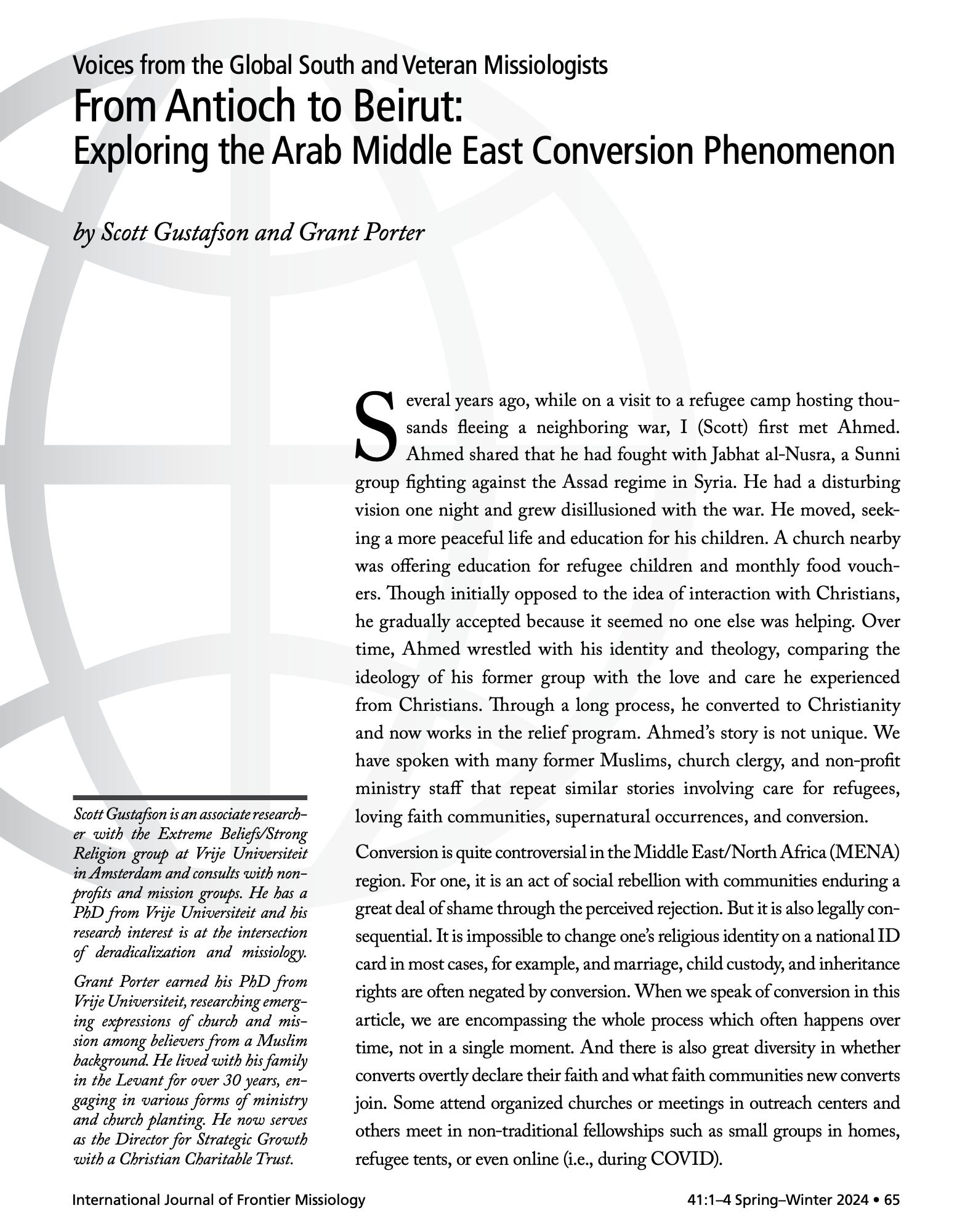
A colleague and I just finalized a landmark study in conversion growth of the church in the Middle East and North Africa. Conversion to Christianity of this scale is at a historic level not seen in the Levant since the 1st century. You can read the whole journal article in the International Journal of Frontier Mission here. Below is a summary:
For more than a decade now a large conversion trend in the Arabic-speaking Middle East and North Africa (MENA) has been percolating. The Arab Spring, and the Syrian and Iraqi crises, precipitated humanitarian disasters and the mixing of Christians and Muslim communities in new ways due to massive migration. The COVID-19 pandemic, resource scarcity, wars, and natural and man-made disasters also added to general social upheaval and instability.
While this chaos led to a mass exodus of traditional Christians from places like Iraq and Syria, with very serious population decline, conversion growth of Christianity seems to have increased. We note: “Given that the historical Christian population has reportedly declined to less than 150,000 in Iraq and 300,000 in Syria, the genesis of some 270,000 new Christians in the MENA region is extraordinary.”
During my Ph.D. research I interviewed many who decided to become Christians from a Muslim background, some from very extreme backgrounds. In this new journal article entitled: From Antioch to Beirut: Exploring the Arab Middle East Conversion Phenomenon, a colleague and I explore the quantitative scope of the phenomenon.
Until now, there has not been much research on the size and scale of the phenomenon. It used to be quite rare that anyone would convert to Christianity from a Muslim background, but in the last 10 years or so we would hear people throw around estimates and tell stories about how this was becoming more commonplace. Our study, just published open access in the International Journal of Frontier Missiology, is the first to attempt a broad quantitative analysis of the scope of the phenomenon. We utilized a survey of churches, denominations and non-profits in the MENA region and compared it with another larger dataset. What we found is pretty astounding… we argue that conversion to Christianity of this scale is at a historic level not seen in the Levant since the 1st century.
Some of the major findings of the research:
- The conversion phenomenon is at a historic level, with over 270,000 new converts in the last 10 years (comparison data indicates 650k+).
- Reversion (back to Islam) seems to be quite low compared to what was previously accepted at ~26%. (Previous studies indicate upwards of 90%)
- The top 3 pressing needs for the church in the MENA region: Next Generation leaders, Maturity/Character Development, Finances/Material Needs
- 5 factors that contributed to the phenomenon: social upheaval, exposure to the gospel, engagement of loving, missional Christians, humility and repentance, and belonging in community.
“The conversion phenomenon underway in the MENA region is being written by marginalized groups in a context of war and precarity who move in directions opposite prevailing forces of culture and politics. In contrast to a historical emphasis on the story of “empire,” the history of global Christianity is written by migrants and disempowered groups. We see missional Christians in the MENA offering a compelling alternative to the status quo: a surprising alternative community in a hostile and chaotic milieu. These communities are living as a “sign, foretaste and instrument of the coming Kingdom” that Jesus inaugurated. The next chapter of global Christianity is being written in the MENA, authored by the refugee and Arab evangelical church in the Middle East.”
